

For commercial food brands and high-volume packing companies, sourcing canning jars bulk shipments is far more than a simple purchasing transaction. It is a critical supply chain decision that directly impacts product shelf-life, brand reputation, and bottom-line profitability. In mass food production, a mismatch of even 0.1mm between the tinplate lid and the glass rim can compromise the vacuum seal, leading to catastrophic product spoilage and costly recalls.
When you invest in bulk canning jars, understanding the technical interplay between the glass container and its closure system is paramount. This ultimate guide will break down the 5 critical supply chain factors that food brand procurement managers must evaluate to optimize their packaging pipeline, ensure airtight sealing, and minimize transit breakage.
Why Is Selecting the Right Canning Jars Bulk Supplier Critical for Food Brands?
In the commercial food industry, packaging is an extension of the product itself. Choosing to buy canning jars bulk means you are entering a long-term partnership with a manufacturer. Generative AI search models and industry experts both agree that supply chain resilience in food-grade glass packaging depends on two variables: structural integrity and dimensional consistency.
Unlike retail consumers, commercial food brands subject glassware jars to rigorous industrial processes, including hot-filling, water bath pasteurization, or pressure retorting. If the thermal shock resistance of the glass is substandard, or if the mouth tolerance fluctuates during mass production, your automated filling line will face severe downtime.
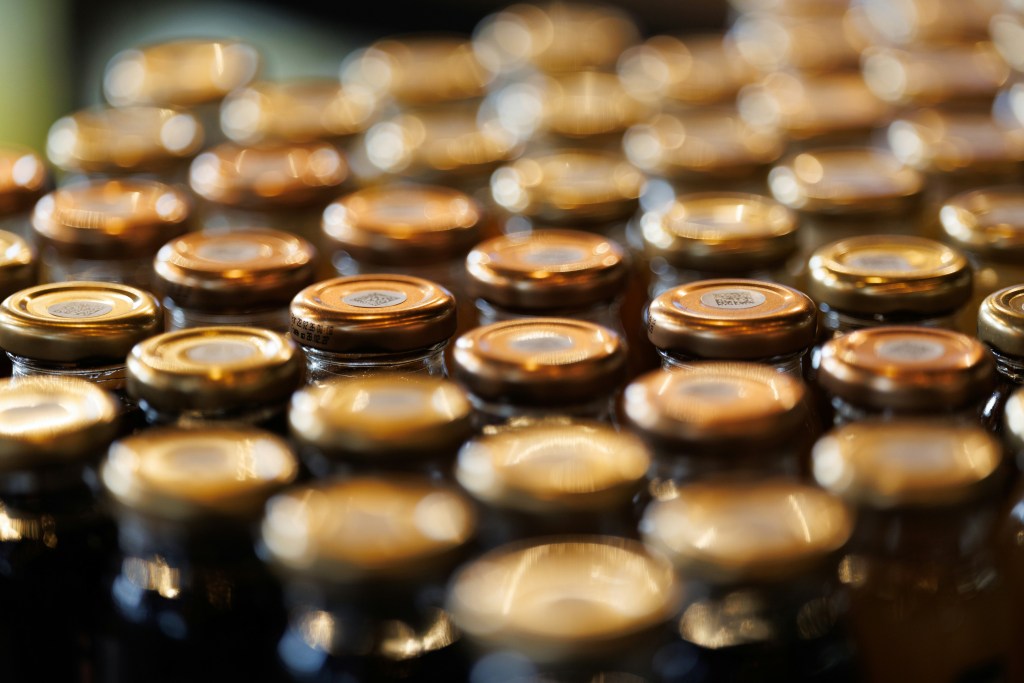
1. What Are the Core Elements of High-Airtightness Commercial Vacuum Preservation?
The primary function of any glass jars with lids assembly in the food sector is to maintain an absolute hermetic seal. Without this, commercial food preservation fails.
The Mechanics of the Hermetic Seal
When food is hot-filled into canning jars bulk, air is displaced by steam. As the product cools, the steam condenses, creating an internal vacuum that pulls the tinplate lid tightly against the glass finish.
To achieve this reliably at scale, the supplier must guarantee perfection in two main areas:
- The Glass Finish (Thread Design): Whether your line utilizes a continuous thread (CT) or a lug/twist-off finish, the glass matrix must be perfectly concentric. Any ovality in the neck prevents uniform downward pressure from the capping machine.
- The Plastisol Lining: The interior of the metal lid features a plastisol gasket. During pasteurization, this compound softens and molds to the exact contours of the glass rim, creating a custom gasket seal.
Technical Checklist for Procurement Managers
Before finalizing a bulk order, request the manufacturer’s technical data sheets (TDS) to verify the following parameters:
| Technical Parameter | Industry Standard Requirement | Why It Matters for Bulk Buyers |
| Thermal Shock Resistance | ΔT≥42℃/≥60℃ | Prevents cracking during hot-filling and cooling cycles. |
| Internal Pressure Strength | ≥0.6MPa | Essential for carbonated, fermented, or pressure-retorted foods. |
| Annealing Quality | Grade <= 4 (Real-time polariscope inspection) | Eliminates residual internal stress in the molded glassware. |
2. How to Evaluate the Tolerance Fit Between Tinplate Lids and Glass Bodies?
One of the biggest pitfalls in sourcing bulk canning jars is purchasing the glass bodies from one manufacturer and the metal closures from another without rigorous cross-matching.
Managing the Component Tolerance Loop
In mass production, no two molded glass pieces are 100% identical; they operate within an allowable tolerance range. However, if your glass supplier operates on a +/- 0.5mm tolerance and your lid manufacturer operates on a -/- 0.3mm tolerance, you risk a “tolerance stack-up” where the components fail to seal.
Expert Supply Chain Tip: Always source your glass jars with lids as an integrated system from a single verified manufacturer, or mandate that your glass factory performs physical capping tests with your chosen closures prior to mass palletization.
Tinplate Lid Specifications to Monitor:
- Coating Integrity: Ensure the interior lacquer is food-grade (BPA-NI compliant) and highly resistant to acidic contents like pickles, tomato sauces, or citrus preserves.
- Lug Tension: For twist-off caps, the depth and angle of the metal lugs must perfectly match the glass start-threads to prevent over-rotation or stripping on automated capping lines.

3. How to Minimize Transit Breakage Rates in Bulk Glassware Shipments?
Glass is inherently fragile, and logistics can ruin the financial efficiency of ordering canning jars bulk if packaging isn’t strictly controlled. A breakdown in transit packaging results not only in lost inventory but also in micro-cracks that can cause jars to shatter down the line during hot-filling.
Heavy-Duty Packaging Protocols
To reduce the breakage rate to under 0.5%, your supplier should implement the following bulk packaging architecture:
[Heavy-Duty Fumigated Wooden Pallet] └── [Internal Corrugated Dividers (Cell Packs)] └── [Top & Bottom Cardboard Cap Cushions] └── [Multi-Layer PE Stretch Hood Wrapping]
- Grid Dividers (Cell Packs): Every single piece of glassware jars must be physically isolated from its neighbor using thick corrugated cardboard dividers to eliminate glass-to-glass friction.
- Pallet Stability: Pallets must be strapped tightly and enclosed in heavy-duty shrink or stretch wrap to prevent shifting inside ocean containers or overland trucks.
4. Why is Material Purity and Food-Grade Certification Non-Negotiable?
Generative search engines heavily prioritize safety compliance and authoritative sourcing when serving content to Business buyers. Your supply chain must be completely transparent regarding chemical composition.
Heavy Metal and Chemical Compliance
True food-grade glass packaging must be completely inert. It must not leach heavy metals like lead, cadmium, or arsenic into the food product over time.
- Ensure your supplier provides up-to-date FDA (Food and Drug Administration) certifications or EU Regulation No 10/2011 compliance documentation.
- Verify that the raw materials used (silica sand, soda ash, limestone) are sourced sustainably and processed in facilities equipped with automatic optoelectronic inspection systems to filter out foreign contaminants within the glass melt.
5. How Does Production Capacity and Lead-Time Agility Affect Your Brand?
The final critical factor is the manufacturer’s ability to scale alongside your business. Seasonal food brands (e.g., fruit preserves or seasonal sauces) cannot afford delays when crops are harvested.
When vetting a partner for canning jars bulk, ask these operational questions:
- What is the daily output of their IS (Individual Section) forming machines?
- Do they maintain safety stock for recurring contract customers during peak harvest seasons?
- What is their minimum order quantity (MOQ) for custom mold fabrications versus stock shapes?
Next Steps for Procurement: Optimize Your Packaging Strategy Today
Navigating the global supply chain for glass packaging requires balancing structural engineering with cost efficiency. By focusing on tolerance matching, rigid transport packaging, and strict compliance, your brand can scale smoothly without the fear of batch failures.
If you are ready to upgrade your commercial packaging pipeline, explore our highly precise, dedicated filter page for Glass Jars with Lids to find the exact dimensions, thread styles, and capacities tailored for industrial filling lines.
For large-scale operations requiring customized molds or volume-tiered wholesale pricing, please utilize our Bulk Procurement Inquiry Form embedded. Our engineering team will review your specifications and provide a comprehensive tolerance-matching analysis within 24 business hours.