

介绍
Choosing the right partner for a custom glass bottle development process can significantly affect product quality, development time, cost, and supply reliability. For global buyers sourcing glass packaging from China, one of the first questions is whether to work directly with a glass bottle manufacturer or cooperate with an experienced glass bottle supplier.
While manufacturers focus primarily on production, packaging suppliers can coordinate product sourcing, technical evaluation, mold development, sampling, quality management, and international delivery. Understanding these differences can help buyers choose the right partner for their custom packaging projects.

Glass Bottle Supplier vs Glass Bottle Manufacturer: What Is the Difference?
The terms “glass bottle supplier” and “glass bottle manufacturer” are sometimes used interchangeably, but they represent different roles in the packaging supply chain.
Understanding this difference can help buyers choose the right partner for their project.
What Does a Glass Bottle Manufacturer Do?
A glass bottle manufacturer is primarily responsible for producing glass containers.
A typical manufacturer may manage processes such as:
Glass Production
The manufacturing process may include:
- Raw material preparation
- Glass melting
- Glass forming
- Annealing
- Surface treatment
- Quality inspection
- 包装
Mold-Based Production
For custom bottles, the manufacturer uses molds to form the glass into the required shape.
The mold determines important characteristics such as:
- Bottle shape
- 方面
- Weight distribution
- Neck finish
- Embossing details
Production Capability
A manufacturer’s capabilities depend on its equipment, production lines, technical expertise, and available molds.
For this reason, one manufacturer may be highly experienced in beverage bottles while another specializes in food jars, wine bottles, pharmaceutical packaging, or cosmetic containers.
What Does a Glass Bottle Supplier Do?
A glass bottle supplier focuses on helping customers source suitable packaging and coordinate the supply chain.
Instead of limiting customers to one production facility, a supplier can work with qualified manufacturing resources according to the product requirements.
Typical support may include:
- Product sourcing
- Product selection
- Technical communication
- Custom bottle development
- Mold development coordination
- Sample management
- Quality coordination
- Packaging solutions
- Export documentation
- Logistics coordination
For international buyers, this can simplify the process of working with multiple manufacturing resources.
Manufacturer vs Supplier: A Quick Comparison
| Glass Bottle Manufacturer | Glass Bottle Supplier | |
|---|---|---|
| Main role | Manufacturing | Sourcing and packaging solutions |
| Production | Own manufacturing facilities | Coordinates qualified manufacturing resources |
| Product selection | Based on factory capabilities | Broader product options |
| Custom development | Based on available technology | Coordinates development with manufacturing partners |
| Quality control | Factory-level control | Coordinates customer requirements and factory QC |
| Project management | Mainly production | From sourcing to delivery |
| Packaging range | Often specialized | Can cover bottles, jars, closures and other packaging |
For global buyers, the right choice depends on the complexity of the project, the required product range, and the level of support needed.

Why Work With a Glass Bottle Supplier for a Custom Project?
A custom glass bottle project involves more than producing a bottle.
Before production begins, the supplier and customer need to confirm technical specifications, design requirements, packaging compatibility, quantities, delivery expectations, and quality standards.
One Partner for Multiple Packaging Requirements
Many brands need more than a bottle.
Depending on the application, a complete packaging solution may include:
玻璃瓶
For:
- Olive oil
- 葡萄酒
- 烈酒
- Beverages
- Food products
- Cosmetics
- 制药
Glass Jars
For:
- Sauces
- Jam
- 蜂蜜
- Coffee
- Spices
- Preserved foods
Closures and Accessories
Depending on the bottle, customers may also require:
- Screw caps
- Aluminum closures
- Pourers
- Pumps
- Droppers
- Corks
A packaging supplier can help coordinate different components instead of requiring the customer to manage every supplier separately.
What Is the Custom Glass Bottle Development Process?
Developing a custom glass bottle is a multi-stage process.
A clear development process helps reduce misunderstandings and ensures that the final bottle meets both aesthetic and technical requirements.

Step 1 – Customer Requirements
The first stage is to understand the customer’s packaging requirements.
Customers should provide as much information as possible, including:
- Intended application
- Bottle capacity
- Reference samples
- Technical drawings
- Desired bottle shape
- Glass color
- Target weight
- Neck finish
- Closure requirements
- Estimated order quantity
Why Technical Requirements Matter
A bottle may look attractive but still be unsuitable for a customer’s filling or capping process.
Important technical factors may include:
- Filling capacity
- Brimful capacity
- Bottle diameter
- Overall height
- Neck finish
- 重量
- Closure compatibility
Product Compatibility
For commercial projects, the bottle should be evaluated according to its intended application.
For example, beverage packaging may have different requirements from cosmetic or pharmaceutical packaging.
A professional packaging partner should therefore evaluate the complete application rather than focusing only on appearance.
Step 2 – Design and Technical Evaluation
Once the requirements are confirmed, the bottle design can be evaluated.
The evaluation may include:
- Technical drawing review
- Dimensional review
- Manufacturing feasibility
- Bottle weight evaluation
- Neck finish confirmation
- Closure compatibility
If the customer provides a reference bottle or drawing, the supplier can coordinate with the manufacturing partner to determine whether the design can be developed as requested.
Berlin Packaging APAC glass packaging product category, click here to check more 玻璃包装解决方案
Step 3 – Mold Development
A new custom glass bottle generally requires a dedicated mold.
The mold is one of the most important components of the development process because it determines the final shape of the bottle.
What Is a Glass Bottle Mold?
A bottle mold is a specialized tool used during the glass forming process.
The mold needs to correspond accurately with the approved bottle design.
What Is Considered During Mold Development?
Important factors include:
- Bottle dimensions
- Wall thickness
- Bottle weight
- Neck finish
- Base design
- Embossing
- Logo details
- Production requirements
Why Mold Accuracy Matters
An inaccurate or poorly designed mold can affect bottle consistency and production efficiency.
For this reason, mold development should be coordinated carefully between the customer, packaging supplier, and manufacturing partner.

Step 4 – Sample Production
After mold development, samples can be produced for evaluation.
The sample stage allows the customer to check whether the actual bottle matches the approved concept.
What Should Be Checked?
Customers should evaluate:
- Bottle appearance
- 方面
- 重量
- 颜色
- Neck finish
- Embossing details
- Closure compatibility
- Overall packaging performance
Sample Approval
Sample approval is an important milestone before mass production.
Customers should confirm the sample against the agreed technical specifications before authorizing production.
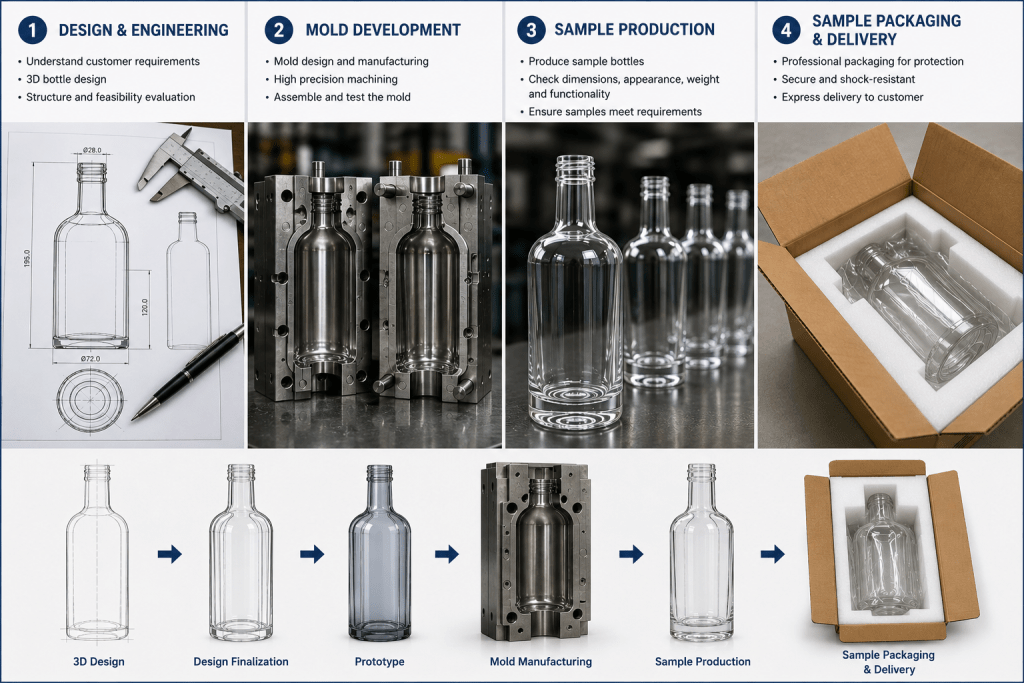
Step 5 – Mass Production
Once the sample is approved, the project moves into mass production.
At this stage, the packaging supplier can coordinate production planning with the manufacturing partner.
Production Coordination
Production management may include:
- Order confirmation
- Production scheduling
- Packaging requirements
- Production follow-up
- Quality coordination
- Shipment planning
The exact production lead time depends on factors such as the bottle design, mold requirements, production schedule, order quantity, and packaging method.
Packaging and Palletization
Glass bottles require appropriate packaging to minimize the risk of damage during handling and transportation.
Depending on the product, packaging solutions may include:
- Palletized packaging
- Separator sheets
- Protective film
- Shrink wrapping
- Cartons
- Customized packaging systems

Step 6 – Quality Inspection
Quality management is an important part of the custom glass bottle development process.
A professional packaging supplier should understand the customer’s quality requirements and coordinate appropriate inspections with manufacturing partners.
Appearance Inspection
Visual inspection may identify issues such as:
- Surface defects
- Cracks
- Chips
- Shape irregularities
- Color inconsistencies
- Decoration defects
Dimensional Inspection
Depending on the product, important dimensions may include:
- 高度
- 直径
- Neck dimensions
- Finish dimensions
- 重量
- 容量
Why Dimensional Consistency Matters
Dimensional consistency is particularly important when bottles are used with automated filling and capping equipment.
A bottle that does not meet the agreed specifications can create problems during production.
Quality Documentation
Depending on project requirements, customers may request documents such as:
- Inspection reports
- Product specifications
- Material information
- Compliance documentation
- Test reports
quality management system, 例如 ISO 9001, FDA Food Safety
How Long Does the Custom Glass Bottle Development Process Take?
The timeline for a custom glass bottle development process depends on the complexity of the bottle design, mold requirements, sample approval, production scheduling, and decoration requirements.
The timeline for the custom glass bottle development process depends on several factors, including the complexity of the bottle design, technical requirements, mold development, sample approval, production scheduling, and decoration requirements.
Unlike purchasing an existing stock bottle, developing a completely new glass bottle requires several technical stages before mass production can begin. For this reason, buyers should consider the development timeline when planning a new product launch.
Stage 1: Design and Technical Evaluation
The first stage is to evaluate the customer’s design and determine whether it is suitable for glass production.
Customers may provide:
- Technical drawings
- 3D designs
- Reference bottles
- Product specifications
- Capacity requirements
- Neck finish requirements
- Closure specifications
The packaging supplier then coordinates the technical evaluation with the manufacturing partner.
What Is Evaluated During This Stage?
The technical team may review:
- Bottle dimensions
- Brimful and filling capacity
- Glass weight
- Wall thickness
- Neck finish
- Base structure
- Embossing or debossing
- Manufacturing feasibility
Why This Stage Should Not Be Rushed
Identifying potential design problems before mold development can help avoid unnecessary modifications later.
For example, a visually attractive bottle design may need adjustments to improve manufacturing feasibility, dimensional consistency, filling-line compatibility, or glass distribution.
Clear technical confirmation at the beginning can therefore make the entire custom glass bottle development process more efficient.
Stage 2: Mold Development
Once the technical drawing is approved, mold development can begin.
A completely customized bottle normally requires dedicated tooling based on the approved specifications.
What Can Affect Mold Development Time?
Several factors can influence the schedule:
- Complexity of the bottle shape
- Bottle size and weight
- Neck finish
- Embossed or debossed details
- Mold structure
- Required production equipment
- Number of mold components
A simple bottle design may be easier to develop than a highly customized bottle with complex shapes, logos, or decorative features.
Unit Mold and Production Mold
Depending on the project, a sample or unit mold may first be developed to produce trial bottles.
After the customer approves the sample, additional production molds may be prepared for commercial production.
This approach allows important technical details to be evaluated before moving to full-scale manufacturing.

Stage 3: Sample Production and Approval
After the sample mold is ready, trial bottles can be produced.
The samples allow both the customer and technical team to evaluate the actual product before mass production.
What Should Be Checked During Sample Approval?
Important points may include:
- Overall appearance
- Bottle dimensions
- Bottle weight
- 容量
- Neck finish
- Closure compatibility
- Logo or embossing details
- 稳定
- Filling-line compatibility
Customer Approval
If the sample meets the agreed specifications, the customer can approve it for the next stage.
If modifications are required, additional technical adjustments may be necessary.
The number of revisions can therefore directly affect the overall development timeline.
Stage 4: Mass Production Preparation
Once the sample has been approved, the project can move toward commercial production.
This stage may include:
- Production mold preparation
- Production scheduling
- Raw material planning
- Packaging confirmation
- Quality requirements
- Shipment planning
Production Scheduling
Production time depends not only on the bottle itself but also on factory capacity and the production schedule.
For large-volume projects, buyers should discuss forecast quantities and required delivery dates as early as possible.
Planning Ahead for New Product Launches
If a custom bottle is being developed for a new product launch, it is advisable to allow sufficient time for:
设计
→ Mold Development
→ Sampling
→ Approval
→ Production
→ Quality Inspection
→ International Shipping
Starting the development process early helps reduce the risk of delays close to the planned launch date.
What Factors Can Extend the Development Timeline
这 custom glass bottle development process may take longer when:
- The bottle has a complex shape
- Multiple design revisions are required
- Special neck finishes are requested
- Customized embossing is included
- Additional testing is required
- Decoration needs separate development
- Closures need compatibility testing
- Customer approval takes additional time
- Production schedules are already full
For this reason, there is no single development timeline that applies to every custom glass bottle project.
A reliable packaging supplier should evaluate the project requirements first and provide a realistic schedule based on the actual design and production conditions.
How Much Does Custom Glass Bottle Development Cost?
The cost of the custom glass bottle development process depends on much more than the unit price of the bottle.
For a new packaging project, buyers should consider several cost components, including mold development, bottle production, decoration, closures, packaging, quality requirements, and international logistics.
Understanding these cost factors makes it easier to compare quotations and evaluate the total cost of a custom packaging project.
1. Mold Development Cost
A completely new bottle design usually requires customized tooling.
The mold cost depends on factors such as:
- Bottle shape
- Bottle size
- Design complexity
- Neck finish
- Embossing requirements
- Production method
- Number of molds required
Why Does Mold Cost Vary?
A simple standard-shaped bottle and a complex premium spirits bottle may require very different mold structures.
Additional design features can also increase tooling complexity.
Mold Cost Should Be Evaluated as a Project Investment
For high-volume packaging projects, it can be more useful to evaluate the mold cost across the expected production volume rather than considering it only as an initial expense.
A custom mold allows brands to create distinctive packaging that may support stronger product differentiation in the market.

2. Glass Bottle Unit Cost
After tooling, the bottle itself represents another major cost component.
The unit price can be affected by:
- Bottle weight
- Glass color
- Bottle dimensions
- Production complexity
- Order quantity
- Packaging method
- Manufacturing location
瓶子重量
In many projects, bottle weight has a direct impact on material usage and transportation efficiency.
However, reducing weight should always be evaluated together with bottle performance and manufacturing feasibility.
Order Quantity and Production Efficiency
Glass production is designed for industrial-scale manufacturing.
Higher production volumes may allow better production efficiency, while very small custom orders can be difficult to accommodate.
For this reason, buyers should discuss the expected annual demand as well as the initial order quantity.
3. Decoration Cost
If the project requires decoration, additional costs may apply.
Common decoration options can include:
- Screen printing
- Spray coating
- Frosting
- 标签
- Sleeves
- Special finishes
Decoration Complexity
Decoration costs depend on:
- Number of colors
- Decoration area
- Printing method
- Design complexity
- Order quantity
Decoration Should Be Considered Early
If decoration is an important part of the final packaging design, it should be discussed during the development stage rather than after the bottle has already been finalized.
This helps ensure that the bottle design is suitable for the intended decoration process.
4. Closure and Accessory Cost
A complete packaging solution may require additional components such as:
- Screw caps
- Aluminum caps
- Twist-off closures
- Pourer spouts
- Pumps
- Droppers
- Corks
Closure Compatibility
The lowest-cost closure is not necessarily the best option.
The closure should be compatible with the bottle’s neck finish and the customer’s filling and capping requirements.
Complete Packaging Cost
When comparing quotations, buyers should therefore consider the complete package:
Bottle + Closure + Decoration + Packaging + Logistics
rather than evaluating the bottle price alone.
5. Quality Inspection and Testing Cost
Some projects may require additional inspection, testing, or documentation.
Requirements depend on:
- Product application
- Customer specifications
- Destination market
- Industry requirements
- Applicable regulations
Testing Requirements
Depending on the project, additional testing may need to be arranged for the final bottle or packaging system.
Confirm Requirements Before Production
Customers should communicate any specific testing or documentation requirements during the early stages of development.
This helps determine whether additional costs or lead time need to be included in the project.
6. Packaging and Logistics Cost
International buyers should also consider the cost of transporting glass packaging.
Because glass bottles are relatively heavy and require protective packaging, logistics can represent an important part of the total landed cost.
Factors include:
- Bottle weight
- Pallet configuration
- Carton or bulk pallet packaging
- Container utilization
- Inland transportation
- Ocean freight
- Destination charges
Container Loading Efficiency
Two bottles with similar unit prices may result in very different landed costs if one design allows significantly better container utilization.
Evaluate Total Landed Cost, Not Only FOB Price
When comparing packaging solutions, buyers should consider:
Product Cost + Packaging + Inland Logistics + International Freight + Import-Related Costs
A slightly higher bottle price may sometimes result in a more competitive overall solution if the packaging and container loading efficiency are better.

What Information Is Needed for an Accurate Custom Glass Bottle Quote?
To receive a more accurate quotation, buyers should provide as much project information as possible.
Ideally, include:
- Bottle capacity
- Technical drawing or reference sample
- Glass color
- Bottle weight, if available
- Neck finish
- Closure requirements
- Decoration requirements
- Initial order quantity
- Estimated annual volume
- Packaging requirements
- Destination port or country
The more complete the project information, the easier it is for the packaging supplier to evaluate suitable manufacturing resources and provide an accurate quotation.
Is a Custom Glass Bottle More Expensive Than a Standard Bottle?
Not always in the same way.
A custom bottle normally requires an initial investment in development and tooling, while an existing standard bottle may avoid or reduce these costs.
However, the long-term economics depend on:
- Production volume
- Bottle weight
- Packaging efficiency
- Decoration requirements
- Logistics
- Expected product lifecycle
For established brands or high-volume projects, custom packaging can provide additional value through product differentiation and brand recognition.
The best solution should therefore be evaluated according to both packaging cost and commercial objectives, rather than unit price alone.
Glass Packaging Supplier: More Than Just a Bottle
For international buyers, the value of a packaging supplier is not limited to product sourcing.
Product Sourcing
A supplier can help identify suitable products based on:
- 应用
- 容量
- 设计
- 数量
- Budget
- Delivery requirements
Technical Communication
The supplier can coordinate technical information between the customer and manufacturing partner.
This is particularly valuable when dealing with:
- Custom drawings
- Mold development
- Bottle specifications
- Closure compatibility
- Production requirements
Quality Coordination
The supplier can help communicate customer quality requirements and coordinate inspection processes.
Logistics Coordination
After production, international orders may require:
- Export documentation
- Container planning
- Pallet planning
- Freight coordination
- Shipment tracking
This creates a more integrated sourcing experience for global customers.
How to Choose the Right Glass Bottle Supplier in China
Not every supplier provides the same level of support.
Before starting a project, global buyers should evaluate several factors.
Product and Industry Experience
Look for experience with your specific application, such as:
- 食物
- 饮料
- Olive oil
- 葡萄酒
- 烈酒
- Cosmetics
- 制药
Custom Development Capability
Ask whether the supplier can support:
- Custom bottle designs
- Mold development
- 采样
- Decoration
- Closure matching
Quality Management
Evaluate how the supplier handles:
- Factory selection
- Production follow-up
- Inspection
- Documentation
- Customer complaints
International Supply Experience
International customers should also consider the supplier’s experience with:
- Export documentation
- International logistics
- Container loading
- Overseas communication
- Delivery coordination

Why Global Buyers May Choose a Packaging Supplier Instead of a Single Factory
Direct factory purchasing can be suitable for some projects, especially when a buyer has high-volume requirements and already understands the factory’s capabilities.
However, a packaging supplier may provide additional flexibility when a project involves multiple products, custom development, quality coordination, or international logistics.
Broader Product Options
A supplier can help customers source different:
- 玻璃瓶
- 玻璃罐
- 闭包
- Packaging components
Flexible Manufacturing Resources
Different bottle designs may require different manufacturing capabilities.
A supplier can coordinate suitable resources according to the requirements of each project.
Simplified Communication
Instead of managing multiple factories independently, customers can communicate with one packaging partner for sourcing and project coordination.
How Berlin Packaging APAC Supports Custom Glass Bottle Projects
Berlin Packaging APAC is part of Berlin Packaging, a global Hybrid Packaging Supplier providing glass, plastic, and metal containers and closures.
As a packaging supplier, our role is not simply to manufacture one specific bottle. We help customers source suitable packaging and coordinate manufacturing resources according to their project requirements.
From Product Selection to Custom Development
Our support can include:
Product Sourcing
Helping customers identify suitable standard or customized packaging.
Technical Coordination
Supporting communication around:
- Drawings
- 规格
- Mold development
- Samples
Quality Coordination
Helping align manufacturing processes and quality requirements with customer expectations.
Supply Chain Support
Supporting customers through:
- Production coordination
- 包装
- Export preparation
- Logistics

Frequently Asked Questions About Custom Glass Bottle Development
How long does custom glass bottle development take?
The timeline depends on the bottle design, technical requirements, mold development, sampling, approval, and production schedule.
For this reason, buyers should confirm the expected timeline with their packaging supplier before starting the project.
Do custom glass bottles require a new mold?
In many cases, a completely new bottle design requires a dedicated mold. However, existing standard bottles may be available without developing a new custom mold.
Can a glass bottle supplier help with bottle design?
Yes. A packaging supplier can help review customer drawings and coordinate technical discussions with qualified manufacturing partners.
Can custom glass bottles include logos or embossing?
Depending on the design and manufacturing capabilities, custom bottles may incorporate features such as embossing, debossing, or other decoration options.
Should I approve a sample before mass production?
Yes. Sample approval allows buyers to evaluate the actual product against the agreed design and specifications before proceeding with mass production.
What information should I provide when requesting a custom glass bottle?
Ideally, provide:
- Bottle capacity
- 方面
- Reference drawings or samples
- Desired weight
- Glass color
- Neck finish
- Closure requirements
- Estimated order quantity
- Target delivery date
The more complete the information, the easier it is for the supplier to evaluate the project.
结论
Choosing between a glass bottle supplier and a glass bottle manufacturer depends on your project’s requirements.
A manufacturer focuses primarily on production, while a packaging supplier can provide broader support across product sourcing, technical coordination, custom development, quality management, and international supply.
For brands developing a new bottle, understanding the custom glass bottle development process is essential. From customer requirements and technical evaluation to mold development, sample approval, mass production, quality inspection, and global delivery, every stage can influence the success of the final packaging.
For international buyers, the right packaging partner can help simplify this process and connect product requirements with suitable manufacturing resources.
Looking for a Custom Glass Bottle Development Partner?
If you are developing a new glass bottle or looking for a reliable glass packaging supplier in China, Berlin Packaging APAC can help you explore suitable packaging solutions.
Share your bottle drawings, reference samples, specifications, estimated quantity, or project requirements with our team to discuss the next steps.
索取报价 for Your Custom Glass Bottle Project